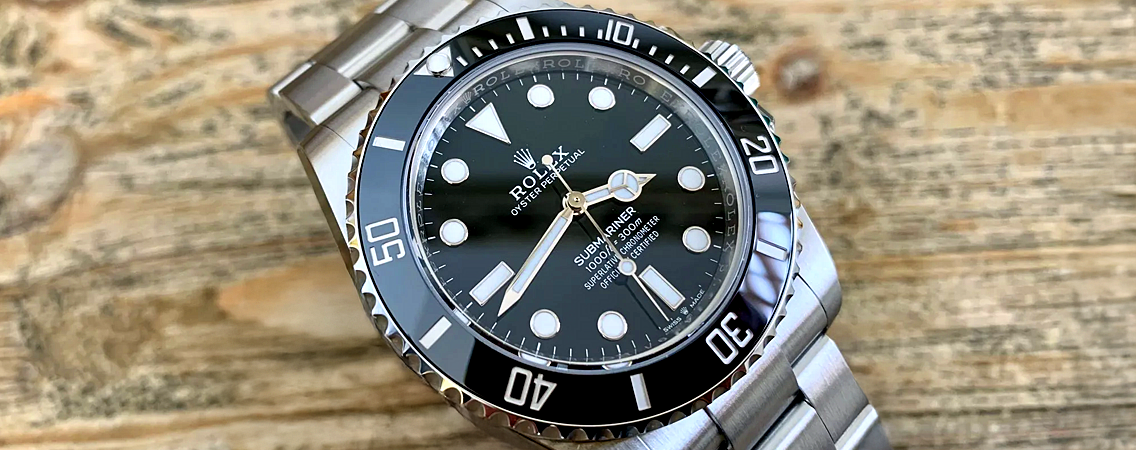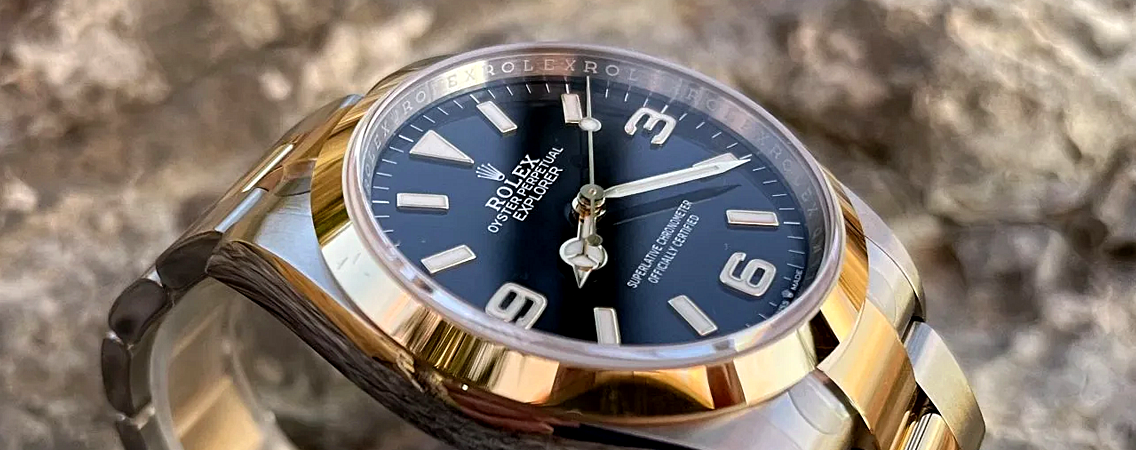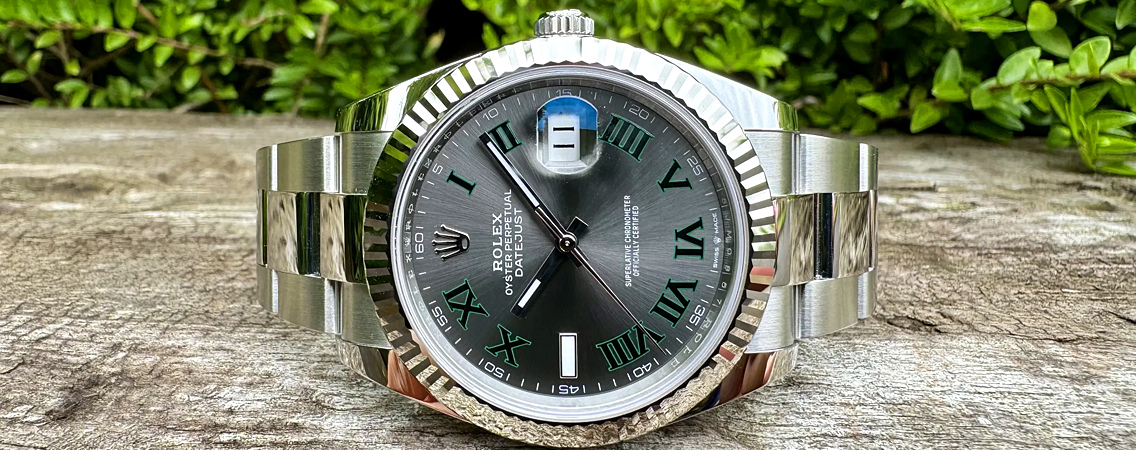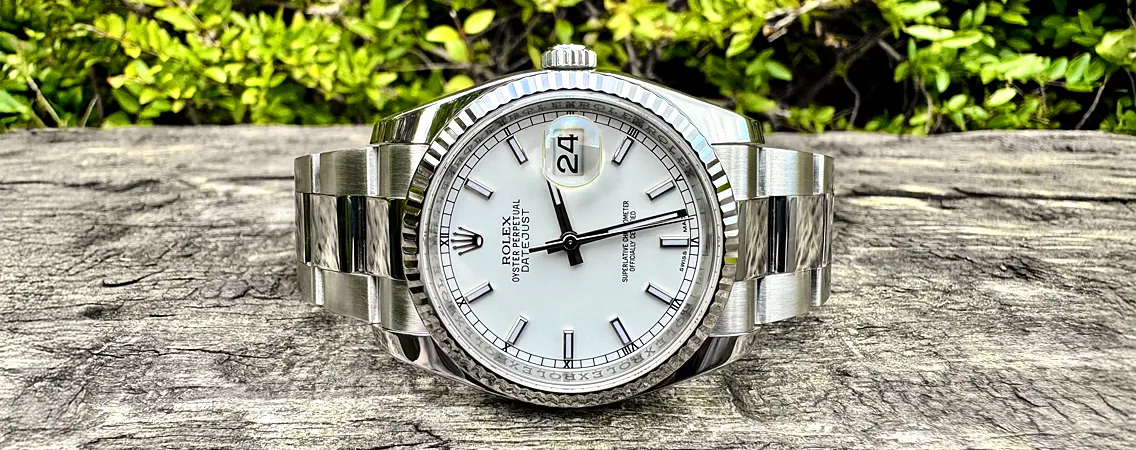
The Rise of Counterfeit Rolex Watches

How to Spot a Fake Rolex

Rolex is one of the most recognised and desirable watch brands in the world, and unfortunately, also one of the most counterfeited. With the rise of high-quality “super fakes,” it’s no longer easy to tell a genuine Rolex from a replica at a glance.

If you’re buying pre-owned, understanding the key signs of authenticity is essential. Every real Rolex is built to exacting standards: precise engravings, smooth movement, solid materials, and perfect detailing. Counterfeits often get one or more of these details wrong.

This guide highlights the main differences between real and fake Rolex watches, helping you buy with confidence and avoid costly mistakes.

Quick Rolex Authenticity Checklist

  • Solid weight: Premium metals give genuine Rolex watches a noticeably substantial feel.

  • Smooth sweep: The second hand should glide cleanly, not tick.

  • Cyclops lens: Clear 2.5× magnification, properly centred over the date.

  • Crisp dial text: Sharp fonts, clean printing, and perfectly aligned markers.

  • Rehaut & crystal: Correct ROLEXROLEXROLEX engraving and a tiny coronet at 6 o’clock.

  • Quality engravings: Deep, sharp serial and reference numbers; never faint or uneven.

  • Movement: Rolex movements are precise, quiet, and impeccably finished.

  • Documentation: Matching serials, correct paperwork, and verifiable history.

  • Trust your seller: Buying from a reputable specialist is the best protection against counterfeits.

On This Page:

The Rise of Counterfeit Rolex Watches

Weight, Feel, and Build Quality

Movement and Second Hand Sweep

Cyclops Lens and Date Magnification

Dial, Fonts, and Markings

Serial and Model (Reference) Numbers

Case Back and Crown

Bracelet and Clasp Details

Documentation and Provenance

The Movement

Why Trusting Your Seller Matters Most

The Rise of Counterfeit Rolex Watches

The global demand for Rolex watches has created a thriving market for counterfeits. What were once obvious imitations have evolved into sophisticated “super fakes” that can appear convincing even to experienced collectors.

Modern counterfeiters use high-grade materials, automatic movements, and laser-etched details to mimic the appearance of genuine models. These watches often appear authentic in photos or listings, making due diligence more important than ever.

The growth of online marketplaces and social media sales has also made it easier for replicas to circulate. While reputable pre-owned dealers verify every watch through professional inspection, private or unverified sellers may not.

Knowing how to identify a fake Rolex and buying only from trusted, authenticated sources is the best way to protect your investment and ensure your watch is truly genuine.
Browse Our Rolex Watches
Weight, Feel, and Build Quality

Weight, Feel, and Build Quality

One of the quickest ways to spot a fake Rolex is by how it feels in your hand. Genuine Rolex watches are built from premium materials such as 904L stainless steel, 18k gold, and 950 platinum, giving them a distinct solidity and balance. Rolex’s proprietary 904L steel, denser, more corrosion-resistant, and brighter than the 316L steel used by most manufacturers, adds to the unmistakable weight and quality of an authentic piece.

When assessing a Rolex, pay attention to the following:

  • Weight and density: A real Rolex feels substantial. Counterfeits often use cheaper alloys or hollow components, resulting in a lighter, hollow feel.

  • Finishing quality: Authentic Rolex cases and bracelets have smooth, even finishing with no sharp edges or rough spots. The polish and brushing should be consistent throughout.

  • Bracelet construction: Modern Rolex bracelets are made with solid links and end links, giving them a reassuring heft. Older models such as the GMT-Master II 16710 and Explorer II 16570 used hollow stamped links and end links, so they’re naturally lighter but should still feel sturdy and well balanced.

  • Material authenticity: Rolex uses only premium materials, including 904L stainless steel, 18k yellow, white, or Everose gold, and 950 platinum. Two-tone watches use Rolesor (steel and gold), while some Yacht-Master models combine Rolesium (steel and platinum).

  • Clasp action: The clasp on a genuine Rolex closes with a smooth, firm click, not a loud snap. Any looseness, stiffness, or rattling when handling the bracelet is a warning sign.

A genuine Rolex feels solid, balanced, and meticulously finished. Counterfeits rarely achieve the same density or refinement, no matter how convincing they may appear visually.

Movement and Second Hand Sweep

The movement inside a Rolex is one of its most distinctive and defining features. Every genuine Rolex uses a Swiss-made mechanical movement, either automatic or, in rare cases, quartz (such as the discontinued Oysterquartz line). These movements are designed and built entirely in-house by Rolex, known for exceptional precision and reliability.

A key visual cue is the smooth sweep of the seconds hand. In a genuine Rolex, the seconds hand moves almost fluidly, completing around eight tiny movements per second thanks to the high beat rate of the movement (typically 28,800 vibrations per hour). This creates the illusion of a continuous, gliding motion.

By contrast, most fake Rolex watches use lower-quality mechanical or quartz movements that tick once per second or move in noticeably uneven increments. Even counterfeit watches fitted with automatic movements often have an inconsistent or jerky sweep when compared side by side with the real thing.

Another telltale sign is sound. A genuine Rolex runs almost silently; you shouldn’t hear a loud “tick.” If you can hear a pronounced ticking noise when you hold the watch close to your ear, it’s likely a replica.

Rolex movements are also extremely smooth when winding or setting the time. The crown should turn effortlessly but with a precise, solid feel. Excessive resistance, roughness, or slack in the winding mechanism can indicate a counterfeit or poor-quality movement.

Ultimately, the movement defines the Rolex experience: silent, smooth, and seamless. A fake may look convincing, but the motion of the seconds hand and the feel of the winding crown often tell the real story.
Cyclops Lens and Date Magnification

Cyclops Lens and Date Magnification

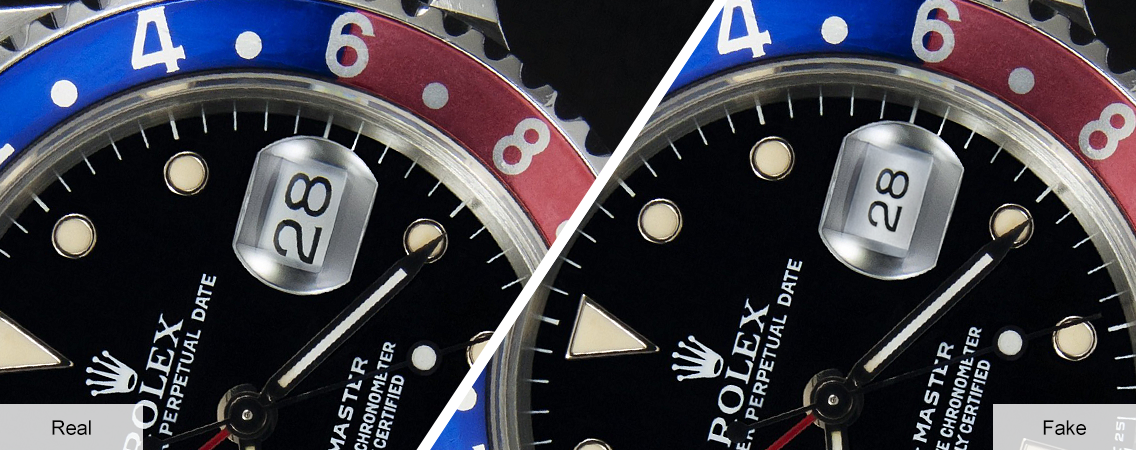
On Rolex models with a date display, one of the most distinctive features is the Cyclops lens, the magnifying bubble built into the sapphire crystal above the date window. Its clarity and precision are key indicators of authenticity.

A genuine Rolex Cyclops lens magnifies the date by 2.5 times, producing a sharp, perfectly centred, and distortion-free image. The lens itself is convex, forming a noticeable raised bump you can feel on the crystal; a reassuring sign of authenticity.

By contrast, counterfeit watches often fail to replicate this detail. Common warning signs include:

  • Flat or barely raised lenses that sit flush with the crystal surface.

  • Weak magnification – often only 1.5× or less.

  • Off-centre alignment between the lens and the date window.

  • Distorted or blurry numerals when viewed through the lens.

  • No anti-reflective coating, leading to excessive glare under light.

  • Visible glue or uneven edges where the lens meets the crystal.

It’s also important to know that not every Rolex with a date display includes a Cyclops lens. Models such as the Sea-Dweller and Deepsea Sea-Dweller omit it entirely to maintain their extreme depth-rating integrity.
Dial, Fonts, and Markings

Dial, Fonts, and Markings

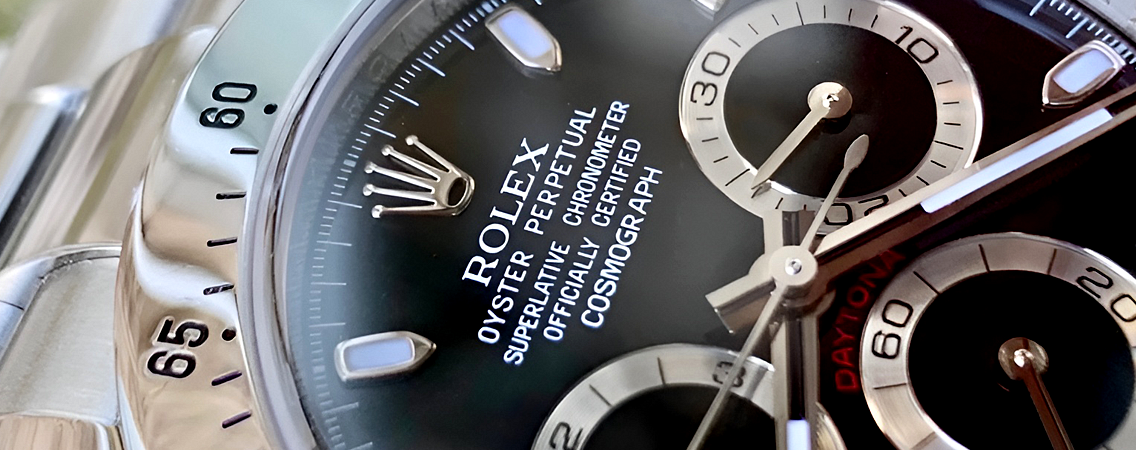
The dial of a Rolex is where the brand’s craftsmanship and precision are most visible, and where counterfeits often fall short. Every genuine Rolex dial is perfectly balanced, with crisp text, consistent font sizes, and flawless alignment between markers and print.

When inspecting the dial, look for the following:

  • Print quality: Genuine Rolex dials feature ultra-sharp, detailed printing. The text should appear solid and smooth, even under magnification. Fakes often have slightly fuzzy or uneven lettering.

  • Logo detailing: The Rolex crown logo at 12 o’clock should be finely defined, with even, symmetrical points. Counterfeit versions often have thicker or poorly shaped crowns.

  • Hour markers and lume: Authentic markers are applied with precision and sit evenly on the dial surface. The luminous material (lume) should be cleanly applied, with no overflow or discolouration.

  • Hands alignment: On a real Rolex, the hour, minute, and seconds hands align perfectly with the markers when viewed straight on. Misalignment, wobble, or poor finishing are signs of a fake.

  • Model-specific accuracy: Ensure the dial layout, font, and logo placement match the reference number. Many counterfeits mix elements from different models, which can be an immediate giveaway.

Another key authenticity feature on modern Rolex watches is the rehaut engraving, the inner bezel ring between the dial and the crystal. Since 2004, Rolex has engraved “ROLEXROLEXROLEX” around the rehaut and placed the serial number precisely at the 6 o’clock position. On genuine watches, these engravings are razor-sharp and perfectly aligned with the hour markers, while fakes often have shallow, rough, or misaligned text.

The dial and rehaut are protected by sapphire crystal, a scratch-resistant glass that replaced acrylic across the Rolex range. Built into this crystal is one of Rolex’s most subtle identifiers, a micro-etched crown at the 6 o’clock position. Introduced in 2002, this tiny laser-engraved coronet is almost invisible without magnification and extremely difficult to reproduce accurately, making it one of the most reliable signs of authenticity.

For added reassurance, it’s always worth comparing your watch against official Rolex imagery from the brand’s website. Each model and reference has distinct design details; even small differences in text spacing, logo shape, or dial colour can reveal a counterfeit.
Serial and Model (Reference) Numbers
Image credit: hollywoodgems.com license CC BY-NC 4.0

Serial and Model (Reference) Numbers

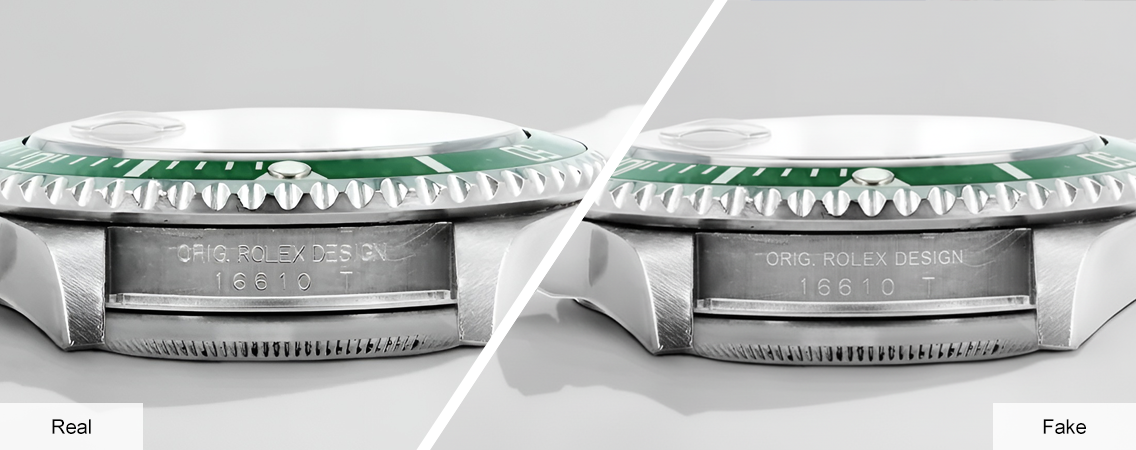
The serial and model numbers on a Rolex are among the most reliable indicators of authenticity. These engravings identify both the individual watch and the specific model configuration, details that are crucial when verifying a pre-owned Rolex.

Where to Find the Numbers

On older Rolex models, both numbers are engraved between the lugs:

  • The model (reference) number appears at the 12 o’clock position.

  • The serial number appears at the 6 o’clock position.

To view them, the bracelet must be carefully removed.

From around 2005 onwards, Rolex began engraving the serial number on the inner rehaut, the smooth metal ring between the dial and the crystal. This made it easier to confirm authenticity without removing the bracelet and harder for counterfeiters to reproduce accurately.

How to Read Them

Reference numbers identify the specific Rolex model, material, and sometimes the bezel or bracelet type (for example, 126610LN denotes a Submariner Date in stainless steel with a black bezel).

Serial numbers are unique to each watch and can be used to estimate the approximate year of production.

When inspecting these engravings, look for the following signs of authenticity:

  • Sharp, precise engraving: Genuine Rolex numbers are laser-etched with clean, even depth and fine detail. They appear crisp under magnification, not rough or sandblasted.

  • Perfect alignment: The numbers and letters should be evenly spaced and centred. Counterfeits often have irregular spacing or uneven depth.

  • Correct formatting: Each Rolex model follows a consistent structure. Reference or serial numbers that don’t match known Rolex patterns are a red flag.

  • Matching paperwork: The serial and reference numbers must match the details on the warranty card, service records, and original paperwork.

To confirm production periods, you can cross-check the serial number using our Rolex Serial Number Chart To help you identify when your watch was made and which range it belongs to.

Remember that counterfeiters sometimes reuse or copy genuine serial and reference numbers. The engraving quality itself, not just the digits, remains one of the strongest indicators of authenticity.
Case Back and Crown

Case Back and Crown

The design and finishing of a Rolex case back and crown offer several clear indicators of authenticity. While counterfeiters can imitate the look of a Rolex dial or bracelet, they often fall short in reproducing these finer construction details.

Case Back

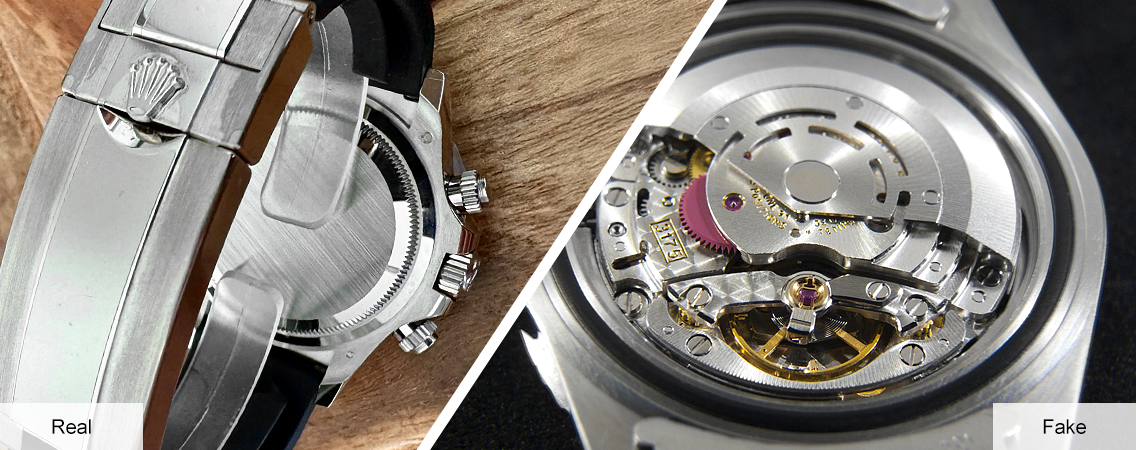
Most genuine Rolex watches feature a smooth, unmarked case back made from high-quality stainless steel, gold, or platinum. The surface should be clean, solid, and free from decorative engravings or transparent “exhibition” windows.

If a Rolex has a see-through case back or visible branding such as “Rolex,” “Geneva,” or model names etched into the rear, it’s almost certainly a fake. There are only a few exceptions to this rule, notably certain vintage or exhibition models produced in very limited numbers, and the Cellini line, which sometimes features decorative detailing.

You should also note that Rolex case backs require a special tool to open. They are precision-sealed for water resistance, and the grooves on the case back should be evenly machined with a solid, high-quality finish. Shallow, uneven, or roughly cut grooves are another sign of inauthenticity.

Crown

The winding crown is one of the most recognisable elements of a Rolex and an area where precision really matters. On a genuine watch:

  • The Rolex coronet logo is finely detailed, with symmetrical points and smooth engraving.

  • The crown screws down securely, turning smoothly with firm, consistent resistance.

  • The triple-dot, twin-dot, or line markings beneath the coronet (on many Oyster models) indicate the type of Triplock or Twinlock water-resistance system fitted; a detail many counterfeits overlook or reproduce incorrectly.

By contrast, fakes often have:

  • Poorly defined or oversized crown logos.

  • Loose or gritty screw-down action.

  • Incorrect or missing lock markings.

Together, the case back and crown provide simple yet reliable points of comparison.
Bracelet and Clasp Details

Bracelet and Clasp Details

Rolex bracelets and clasps are engineered with exceptional precision, and the smallest details can reveal a watch’s authenticity. While we’ve covered the overall feel and construction quality, it’s equally important to examine the specific markings and mechanisms that distinguish a genuine bracelet from a counterfeit.

Engravings and Finishing

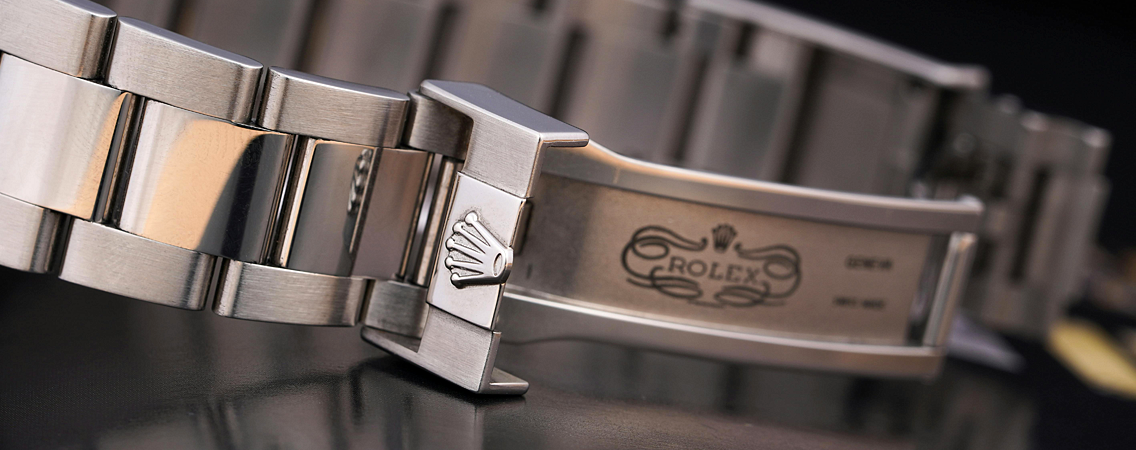
Inside a real Rolex clasp, you’ll find clear, deeply etched engravings, including the Rolex coronet, reference code, and sometimes the stamped production year. These markings are finely detailed and perfectly aligned. Counterfeits often have shallow, uneven, or poorly centred text.

The polishing and brushing on a genuine bracelet are consistent throughout: transitions between polished and satin finishes are smooth, with no rough edges or over-polished surfaces. A fake may show patchy finishing or sharp corners, particularly on the clasp cover and inner hinge.

Clasp Mechanisms

Modern Rolex models use advanced extension systems such as:

  • Easylink – allows for a quick 5 mm adjustment to improve comfort.

  • Glidelock – found on many Submariner and Sea-Dweller models, offering tool-free micro-adjustments.

On genuine watches, these mechanisms glide smoothly and click securely into place. Counterfeits can mimic the look but typically feel loose, stiff, or imprecise when adjusted.

Visual Alignment

When closed, the clasp should sit flush with the bracelet and the Rolex coronet on the clasp cover should be perfectly centred. Misalignment or uneven gaps between the clasp and links are often signs of poor assembly.
Documentation and Provenance

Documentation and Provenance

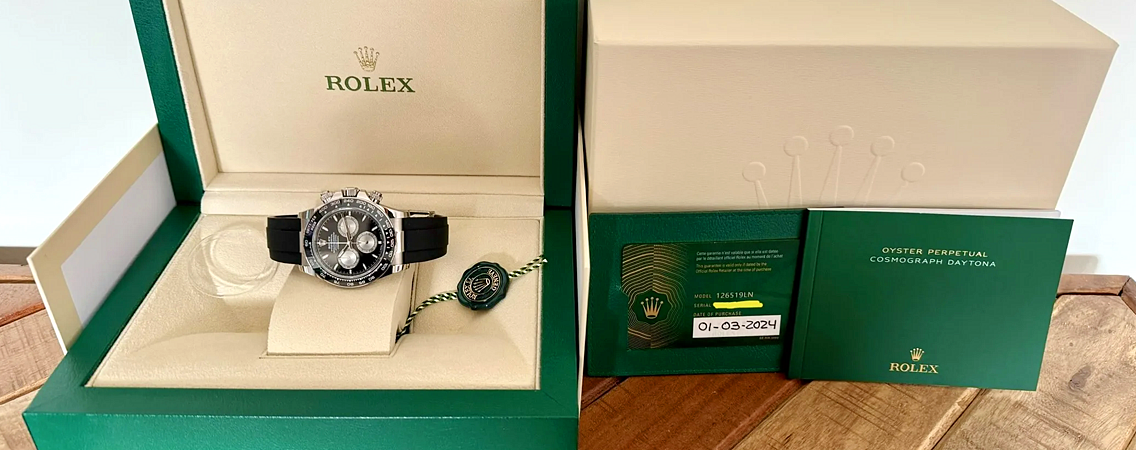
When buying a pre-owned Rolex, documentation is one of the strongest indicators of authenticity and value. While a genuine watch can exist without its papers, having the correct documents and ensuring they match the watch adds confidence, traceability, and resale strength.

What to Expect

A complete Rolex set typically includes:

  • Warranty card or certificate: Lists the serial and reference numbers, model details, and the authorised dealer where the watch was originally sold.

  • Instruction manual and service booklet: Genuine manuals feature high-quality printing and correct model references.

  • Presentation box and outer packaging: Authentic boxes are solid, with quality materials and precise embossing of the Rolex logo.

  • Hang tags: Often include the model and serial numbers, and can confirm the watch’s original configuration.

All documentation should show matching numbers. The serial and reference details on the warranty card must correspond with those engraved on the watch itself. Any discrepancies, missing details, or reprinted paperwork should be treated with caution.

Service History and Provenance

A documented service history from Rolex or an authorised service centre adds strong reassurance. It confirms that the watch has been opened and inspected by qualified technicians and that genuine Rolex parts were used during servicing.

Provenance, the record of previous ownership, also adds value, particularly for collectable or vintage models. Watches with traceable history, original sales receipts, and full paperwork are easier to authenticate and often command a premium.
The Movement
Image credit: char1iej license CC BY-NC-ND 2.0

The Movement

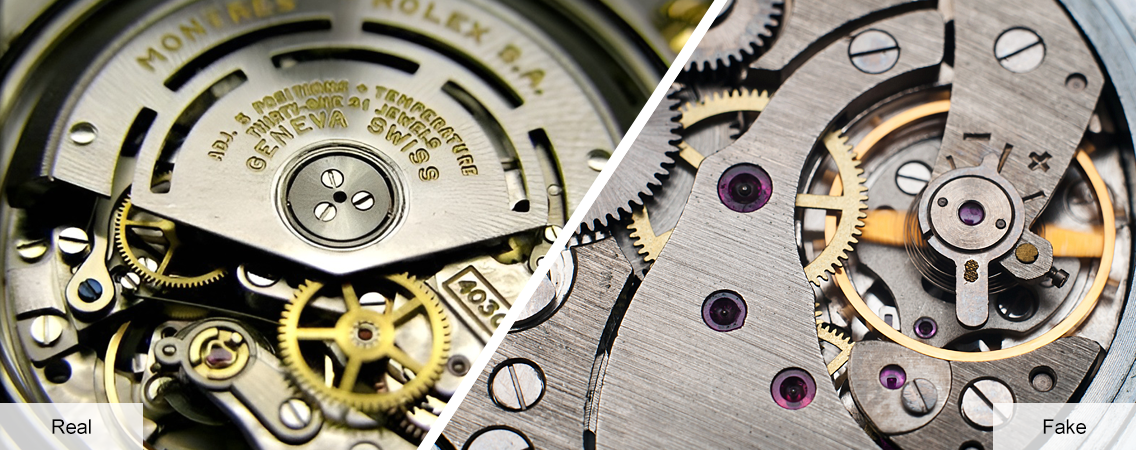
The movement, the mechanical heart of a Rolex, is what truly defines its authenticity. Rolex produces all its movements in-house, and each one is a certified Superlative Chronometer, meaning it meets stringent standards for precision, durability, and performance.

While most authenticity checks can be performed externally, the movement is the ultimate proof of a watch’s legitimacy; however, opening a Rolex case requires specialist tools and should only be done by a qualified watchmaker.

How Genuine Rolex Movements Differ

A true Rolex movement is an example of world-class watchmaking. You’ll find:

  • Flawless finishing: Bridges and rotors are beautifully machined, with clean edges.

  • Distinctive rotor design: Most modern Rolex calibres feature a half-moon-shaped rotor that winds smoothly in both directions.

  • Engraved components: Many internal parts bear the Rolex logo or calibre number, engraved with consistent depth and sharpness.

  • Certified accuracy: Every Rolex movement is first COSC-certified and then tested again by Rolex under its Superlative Chronometer standard of ±2 seconds per day. This certification is reflected on the dial, marked “Superlative Chronometer Officially Certified”, and confirmed by the movement itself, which carries a calibre engraving (for example, 3235 or 4130) and high-grade finishing consistent with Rolex’s chronometer standards. While the COSC stamp isn’t printed on the movement, these identifiers correspond to calibres officially recognised as Superlative Chronometers.

By contrast, counterfeit watches often contain:

  • Basic off-the-shelf movements (such as low-cost automatic or quartz calibres).

  • Poor finishing or unbranded components.

  • Incorrect or missing engraving.

  • No evidence of chronometer certification or consistent accuracy.

Even if a fake appears convincing externally, the internal mechanism nearly always exposes the truth. The difference in quality, precision, and layout becomes immediately apparent to a trained eye.

If you’re in any doubt, have the watch inspected by an authorised Rolex service centre or a qualified independent watchmaker. They can open the case safely, verify the calibre, and confirm whether all internal parts are genuine Rolex components.
Why Trusting Your Seller Matters Most

Why Trusting Your Seller Matters Most

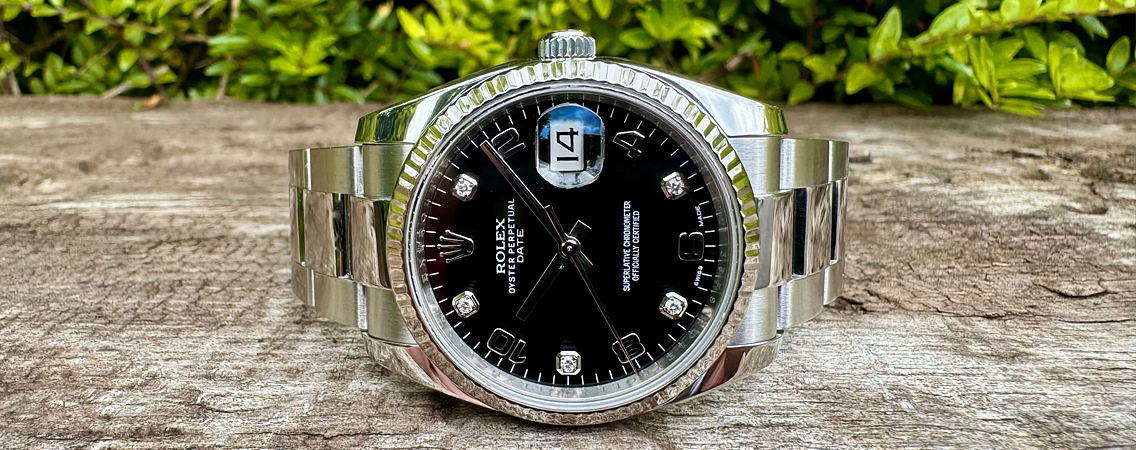
While understanding the technical details of how to authenticate a Rolex is extremely valuable, the most reliable way to ensure you are buying a genuine watch is to purchase from a trusted and reputable dealer. Modern counterfeits can be highly sophisticated, and even experienced collectors can struggle to identify the most convincing fakes without specialist tools and knowledge.

Buying from a respected luxury watch specialist removes that uncertainty entirely. At UK Specialist Watches, every timepiece we offer has been thoroughly inspected, authenticated and vetted by experts with decades of experience in the high-end watch industry. Our diligence, attention to detail and commitment to the highest standards ensure that the watches we source represent some of the finest examples available in the UK.

Unlike informal marketplaces such as eBay, Gumtree or Craigslist, where authenticity is not guaranteed and buyers have limited protection, purchasing from a professional dealer provides complete peace of mind. We guarantee that every watch we sell is 100% authentic, accurately described and in exceptional condition. Our reputation has been built over many years through honesty, expertise and outstanding customer service, with many clients returning to us time and time again.
Buy From UK Specialist Watches With Confidence

Buy From UK Specialist Watches With Confidence

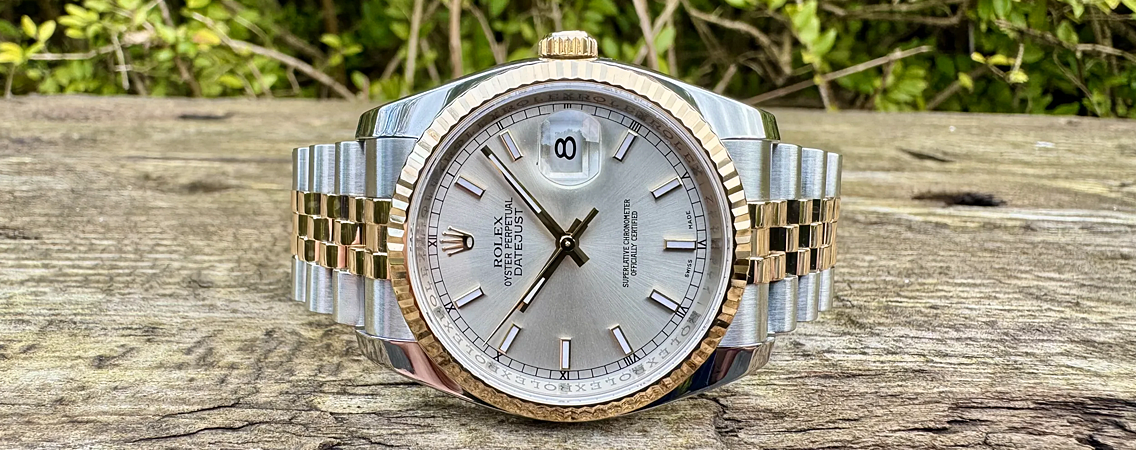
Whether you're investing in your first Rolex or adding to a growing collection, choosing a trusted seller is the most important step you can take. When you buy from UK Specialist Watches, you’re not just purchasing a watch, you’re buying confidence, security and the assurance that your timepiece is exactly what it should be: an authentic, expertly verified example of luxury horology.

Browse Our Rolex Watches
Are Rolex Watches a Good Investment?

Are Rolex Watches a Good Investment?

Few names in luxury carry the weight and mystique of Rolex. For over a century, the brand has symbolised achievement, precision, and quiet confidence; a watch chosen as often for what it represents as for how it performs.

Over the past decade, collectors and investors alike have started viewing Rolex watches as more than fine accessories. They’re increasingly recognised as tangible assets; physical, lasting items that can hold or even grow in value over time. During periods of economic uncertainty, many buyers turned to Rolex as a form of “wearable wealth”, leading to record-breaking secondary-market prices through the early 2020s.

Key Insights

  • Rolex watches have a strong long-term record for value retention, and the brand continues to dominate the global pre-owned luxury watch market.

  • Stainless-steel sports and professional models, such as the Submariner, Daytona, and GMT-Master II, have historically shown the most consistent appreciation.

  • The market has stabilised following the rapid 2020 – 2022 growth period, creating a more balanced environment for buyers.

  • Condition, originality, and documentation remain the biggest factors influencing resale value across all Rolex references.

  • Vintage models continue to attract collectors for their rarity and character, but they require greater expertise when buying.

  • Pre-owned Rolex watches offer today one of the strongest combinations of enjoyment, collectability, and long-term value in the luxury market.

Of course, like any investment, the market for luxury watches has evolved. Prices have cooled from the pandemic-era peaks, creating a more stable environment for informed buyers. For those who value both craftsmanship and financial prudence, pre-owned Rolex watches offer a compelling balance between passion and potential return.

In this guide, we’ll explore whether Rolex watches are a good investment — examining their historical performance, market trends, model-specific opportunities, and the key factors that influence long-term value.

On This Page:

Why Rolex Holds Unique Investment Appeal

Market Performance: 2020–2025

Which Rolex Models Hold or Gain Value?

Choosing with Confidence: How to Find the Perfect Rolex

Why Rolex Holds Unique Investment Appeal

Why Rolex Holds Unique Investment Appeal

Rolex isn’t just the most recognisable name in watchmaking; it’s the cornerstone of the modern luxury-watch market. Its mix of craftsmanship, scarcity, and global trust gives Rolex an investment profile few other brands can match.

1. Precision and Provenance

Rolex’s reputation for reliability is more than marketing. Every component is built in-house, and every watch is tested beyond industry standards. That consistency has earned Rolex the highest resale confidence of any brand — independent reports estimate that it represents around one-third of all luxury-watch sales on the secondary market worldwide.

2. Controlled Supply Meets Constant Demand

Unlike many competitors, Rolex deliberately keeps production limited (about 1.2 million watches a year) despite global demand that far exceeds supply. This scarcity keeps waiting lists long and drives collectors toward the pre-owned market, where popular references like the Submariner, Daytona, and GMT-Master II continue to trade at healthy premiums.

3. Global Liquidity

Because Rolex is recognised everywhere, it functions almost like a universal currency among collectors. A well-kept Submariner or Datejust can be valued and sold in virtually any major city; an advantage few other luxury goods share.

4. Long-Term Value Record

Market data from WatchCharts and Morgan Stanley show that Rolex values surged between 2020 and 2022, then eased through 2023–24 as the market corrected. In 2025, prices have largely stabilised, with steel sports models in particular holding firm. Over ten-year horizons, Rolex remains the strongest long-term performer in its category.

Market Performance: 2020–2025

Market Performance: 2020–2025

The market for Rolex watches over the past five years tells a story of rapid growth, short-term correction, and long-term resilience.

1. The Boom Years (2020–2022)

During and immediately after the pandemic, demand for luxury goods surged. With global travel restricted and retail supply limited, collectors turned to Rolex as a store of value.

Prices for many models soared, some by 50–100% in just two years. The Daytona, Submariner, and GMT-Master II reached unprecedented highs on the secondary market, while waiting lists at authorised dealers stretched for years.

2. The Correction (2023–2024)

By mid-2023, the speculative wave began to ease. Rising interest rates and economic caution led to a cooling phase.

Across the market, Rolex prices fell between 10% and 20% from their 2022 peaks, depending on model and condition.

Rather than signalling a collapse, this represented a return to rational pricing — eliminating short-term speculation and resetting the market on firmer ground.

3. Stabilisation and Opportunity (2025)

By early 2025, the data show that the correction has largely plateaued. Market indices such as WatchCharts’ Rolex Index have reported flat or slightly positive movement in recent quarters.

Collectors are re-entering the market, viewing current prices as a fair reflection of intrinsic value rather than inflated hype. For long-term buyers, this period is widely seen as a more sustainable entry point.

4. A Long-Term Perspective

Looking back over a decade, Rolex remains one of the best-performing luxury assets. Even accounting for recent softening, the average steel sports model has appreciated by 60–80% over ten years, comfortably outpacing inflation and many traditional collectables.

This combination of brand strength, limited supply, and global recognition continues to support Rolex as a stable long-term holding, especially when purchased wisely from verified, authentic sources.

Which Rolex Models Hold or Gain Value?

Which Rolex Models Hold or Gain Value?

While every Rolex benefits from the brand’s reputation for quality and precision, not all models perform equally on the secondary market. Certain categories and references have shown a consistent ability to hold or increase in value, while others prioritise enjoyment over appreciation.

1. Sports and Professional Models

The best-performing Rolex watches historically come from the Professional range; tool watches designed for diving, racing, and exploration. These models combine purpose-built engineering with a design heritage that collectors never tire of.

Among the strongest examples:

Rolex Submariner 
The benchmark dive watch, particularly references such as the Submariner Date 116610LN and the green “Hulk” 116610LV. When the Hulk was discontinued in 2020, prices on the secondary market spiked well above retail, illustrating how scarcity drives demand.

Rolex Daytona
The chronograph most closely associated with performance and status. Modern steel references like the 116500LN have commanded significant premiums since launch, and earlier models — especially vintage “Paul Newman” variants — remain among the most valuable Rolexes ever produced.

Rolex GMT-Master II
Designed for pilots and travellers, versions like the black-and-blue 116710BLNR (“Batman”) and the later 126710BLRO (“Pepsi”) have developed cult followings. When production shifted or bracelets changed, older references often saw renewed collector interest.

Rolex Explorer and Sea-Dweller
Slightly more understated, these models appeal to purists who value heritage and function. Their growth tends to be slower and steadier, with emphasis on originality and condition.

Across the professional range, stainless-steel models consistently outperform precious-metal counterparts in percentage terms. Steel versions are harder to obtain at retail and often have the broadest resale market.

Shop Pre-Owned Rolex Sports Watches

2. Classic Everyday Models

The Datejust and Oyster Perpetual represent Rolex’s timeless design philosophy — elegant, reliable, and versatile. While they don’t experience the rapid appreciation sometimes seen in sports models, they excel in value retention and liquidity.

A well-maintained Datejust (for example, references 16234 or 126200) tends to hold its value remarkably well, especially when paired with classic dial colours and traditional fluted bezels. The more minimal Oyster Perpetual line, once considered an entry point, saw unexpected demand in recent years after colourful dial variants were discontinued, proving that even simple designs can benefit from rarity.

Shop Pre-Owned Rolex Watches

3. Discontinued and Transitional References

When Rolex retires or updates a model, the outgoing reference often gains collector attention. These “transitional” pieces bridge old and new design eras, combining modern reliability with features no longer in production.

For instance:

The Submariner 16610
The last generation to feature an aluminium bezel insert before Rolex moved to ceramic has seen steady appreciation as collectors seek that classic, slimmer profile.

The GMT-Master II 16710
Produced before the switch to the ceramic-bezel 116710, the GMT-Master II 16710 remains prized for its tricolour Pepsi and Coke configurations, and lighter case proportions.

Daytona 16520
Similarly, early Daytona 16520 models with Zenith-based movements mark a pivotal point in the chronograph’s evolution and command premiums over later, more mass-produced versions.These watches illustrate how finite supply and historical context drive value. Once a model is discontinued, production stops forever, and as the years pass, well-preserved examples become increasingly scarce.

Shop Pre-Owned Vintage Rolex Watches

4. Vintage Rolex

Vintage Rolex brings something modern pieces can’t: history and individuality. Each watch tells its own story through subtle details: a faded dial, warm patina, or period typography, which give it unique charm.

Because these watches are long out of production, supply is permanently limited, and the best-preserved examples grow scarcer each year. Classic references such as the Submariner 5513, GMT-Master 1675, and Explorer 1016 remain highly collectable, while lesser-known models can still offer strong value potential as interest spreads across eras.

However, vintage buying requires more expertise. Originality is everything: over-polished cases, replaced parts, or missing documentation can quickly erode value. Servicing older watches can also be more specialised, so it’s worth working with reputable experts familiar with vintage movements and components.

For informed buyers, vintage Rolex can be a rewarding complement to newer models in your collection — combining heritage, rarity, and investment appeal in one piece. 

Shop Pre-Owned Vintage Rolex Watches

Condition and Documentation

Regardless of reference, two factors exert the greatest influence on value: condition and completeness.Unpolished cases, original dials, matching serial numbers, and full sets (box, papers, service records) all contribute to stronger resale prices and greater liquidity.

Watches that have been heavily polished, modified, or lack provenance typically sell for less, even when mechanically identical.

Choosing with Confidence: How to Find the Perfect Rolex

Choosing with Confidence: How to Find the Perfect Rolex

A Rolex is more than a watch — it’s a combination of craftsmanship, heritage, and lasting demand that few other luxury assets can match. Over time, it has proven to be one of the most resilient and recognisable names in the world of collecting, offering both enjoyment and the potential for meaningful long-term value.

That said, investing in Rolex should always be approached with perspective. The market moves in cycles, not straight lines; prices may rise, settle, or correct before climbing again. Not every model will outperform, and maintaining value means caring for each watch properly — servicing, storing, and insuring it as you would any fine asset.

These realities don’t diminish the brand’s strength — they simply remind buyers that the best results come from patience, discernment, and a focus on quality. Choosing models with genuine collector demand, verifying authenticity, and favouring well-preserved examples remain the most reliable ways to protect and grow your investment.

Whether you’re drawn to the rugged appeal of a Submariner, the elegance of a Datejust, or the charm of a vintage classic, a carefully selected Rolex offers something rare: a purchase that can be worn, appreciated, and still hold its place as a genuine store of value.

At UK Specialist Watches, we specialise in sourcing and authenticating exceptional pre-owned Rolex watches — from modern icons to rare vintage references — each selected for its quality, provenance, and collectability.We invite you to explore our current collection and contact our team for friendly, expert guidance on selecting the right Rolex for your style, budget, or long-term investment goals.

Shop Pre-Owned Rolex Watches

How Much Is My Watch Worth?

How Much Is My Watch Worth?

When it comes to luxury watches, one of the most common questions owners ask is: How much is my watch worth? The answer depends on why you’re asking. Some people want to sell their watch and want a realistic resale value. Others are looking to update their insurance and need a replacement valuation. In many cases, collectors are simply curious to know how the market views their watch, especially if it might have gained value over time.

The brand name is often the first thing people consider, but it’s only part of the story. Some watches are valuable because of their cultural significance; Rolex, for example, has become almost synonymous with achievement, while Omega is famous for its link to space exploration and James Bond. Brands like Cartier bring in another layer of desirability by combining horology with their reputation in fine jewellery. On the other hand, highly technical houses such as Patek Philippe or Audemars Piguet are admired for their complications and craftsmanship, which can elevate value well beyond materials alone.

In short, a watch’s worth is determined by more than a single factor; it’s a mix of brand strength, rarity, craftsmanship, condition, and demand. Below, we’ll explore the main elements that influence value, with Rolex examples used throughout to illustrate how these factors play out in practice.

Sell My Watch

Contents

Brand & Model

Reference Number & Rarity

Watch Condition

Originality & Service History

Box & Papers

Age & Vintage Appeal

Market Demand & Trends

Provenance & Unique Features

1. Does Brand Affect Watch Value?

1. Does Brand Affect Watch Value?

Brand reputation is usually the single biggest influence on how much a watch is worth. Rolex is the clearest example, with models such as the Submariner, Daytona, and GMT-Master II often selling above retail because demand consistently outpaces supply. Even simpler references like the Datejust hold strong value thanks to their broad appeal and recognition.

Patek Philippe takes prestige in a different direction. The brand produces far fewer watches each year, which makes many of its models rarer and often more valuable than comparable Rolex pieces. Audemars Piguet demonstrates how distinctive design can add to value, with the Royal Oak commanding premiums due to its iconic style and limited availability.

Ultimately, brand strength reflects more than just quality. It represents recognition, scarcity, and desirability, which is why two watches of similar specification can vary so much in value depending on the name on the dial.

2. How Important Is Rarity and Reference Number?

2. How Important Is Rarity and Reference Number?

Every watch has a reference number that identifies its exact configuration, and rarity often drives value. Certain Rolex references have achieved legendary status among collectors precisely because they were produced in limited numbers or discontinued early. A classic example is the vintage Submariner with a “red” dial variation, which today is worth many times more than a standard Submariner from the same era.

This principle applies across other brands too. Limited editions from Omega, rare dial colours from Patek Philippe, or unusual variations from Panerai can all command premiums. In essence, rarity, whether deliberate or accidental, transforms a watch into something far more desirable than its mainstream counterparts.

3. Does Watch Condition Affect Value?

3. Does Watch Condition Affect Value?

Condition has a huge impact on value, and for many collectors, originality is more important than perfection. A Rolex case that has been heavily polished may look shiny, but it loses the sharp edges that enthusiasts value, and this can reduce its worth. By contrast, a watch that shows gentle, honest wear while retaining its original shape and details is often preferred.

Mechanical condition also matters. A watch that runs well and has been regularly serviced is more attractive to buyers, whereas one with problems in the movement may need expensive work before it can be worn, which lowers its value. Collectors will generally pay more for a watch that is both well-preserved and mechanically reliable.

4. Original Parts vs. Service History – What Matters Most?

4. Original Parts vs. Service History – What Matters Most?

Originality is key when it comes to luxury watches. A Rolex GMT-Master with its original “Pepsi” bezel insert, for example, is almost always worth more than one fitted with a modern service replacement. The same is true for dials and hands; original components, even if they show some ageing, tend to command higher prices than pristine replacements.

That said, service history can still play an important role, particularly for modern watches. Buyers want reassurance that a timepiece has been properly cared for, and recent service documentation from Rolex or another authorised brand centre adds confidence. Ideally, a valuable watch will have both originality and a record of professional servicing.

5. How Much Is My Rolex Worth Without Papers?

5. How Much Is My Rolex Worth Without Papers?

The presence of original box and papers can make a considerable difference. Collectors call this a “full set,” which includes the presentation box, guarantee card or certificate, and any booklets or accessories supplied at the time of purchase. A Rolex Daytona, for example, can be worth 20–40% more when sold with its complete set compared to the same watch without documentation.

This isn’t unique to Rolex – Patek Philippe watches accompanied by their original certificates, or an Audemars Piguet Royal Oak with its full paperwork, are always more attractive to serious buyers. In short, provenance strengthens value, and paperwork helps to prove it.

6. Does Age Increase the Value of a Watch?

6. Does Age Increase the Value of a Watch?

Age alone doesn’t automatically make a watch valuable, but when combined with rarity and desirability, vintage models can become highly sought after. A Rolex Day-Date “President” from the 1960s, especially in precious metal, is a prime example of a vintage Rolex watch with massive appeal. Some pieces develop unique patinas on their dials over time, which adds character and further boosts collectability.

On the other hand, certain modern watches also achieve high secondary-market values despite being relatively new. Stainless steel Rolex sports models, for instance, are notoriously difficult to obtain at retail, meaning pre-owned examples often change hands for a premium. Value, therefore, is not only about age but also about demand in the present market.

7. Do Watch Market Trends Matter?

Absolutely. Watch values are closely tied to collector demand and wider market trends. In recent years, stainless steel sports watches have surged in popularity, often outperforming equivalent gold models. Colour also plays a role, with blue dials across many brands seeing particularly strong demand.

Trends can shift, but they often reinforce the importance of brand and rarity. A design that suddenly becomes fashionable can elevate even long-established models to new heights, while less popular styles may see slower growth in value.

8. Provenance: Can a Watch’s Story Add Value?

8. Provenance: Can a Watch’s Story Add Value?

The story behind a watch can be just as important as the watch itself. A perfect example is the Rolex Daytona owned by Paul Newman, which sold at auction in 2017 for over $17 million. While vintage Daytonas are already highly collectable, the direct connection to the actor — and the fact that this particular model gave rise to the nickname “Paul Newman Daytona” — elevated it into the record books as one of the most valuable watches ever sold.

Other brands have seen similar effects. The Omega Speedmaster worn by astronaut Buzz Aldrin during the Apollo 11 mission is widely considered priceless due to its link with the moon landing. At the high end, the Patek Philippe Grandmaster Chime “Only Watch” sold for $31 million in 2019, not just because of its technical brilliance but because it was a one-of-a-kind piece with a unique story. These examples show how provenance, whether celebrity ownership, historical significance, or unique manufacture, can transform a watch from collectable to legendary.

How Much Is Your Watch Worth?

How Much Is Your Watch Worth?

Determining a watch’s value isn’t an exact science, but it almost always comes down to brand strength, rarity, condition, originality, and completeness.

Get a Professional Valuation

If you’re considering selling your watch, getting an accurate valuation is the first step. Our team specialises in Rolex and other luxury watches, and we can provide a clear, up-to-date market assessment to help you understand what your timepiece is really worth. Whether you own a modern Rolex sports model or a vintage piece with history, we can advise on its value and guide you through the selling process.

Contact us today to get a professional appraisal of your watch.

Sell My Watch

Rolex Serial Numbers Explained

Rolex Serial Numbers Explained

Whether you’re thinking about buying your first Rolex watch or you already own one and are considering selling it, understanding the watch’s serial number is a vital first step. This unique identifier can reveal when your Rolex was made, help confirm its authenticity, and give important clues about its history; all of which are key to determining its true market value.In this guide, we’ll explain exactly what a Rolex serial number is, where to find it, how to use it to date your watch, and what the different formats mean. We’ll also look at how Rolex’s numbering system has evolved, and provide a complete production year chart so you can check your watch straight away.

Contents

What is a Rolex Serial Number?

Where to Find Your Rolex Serial Number

Rolex Serial Number Chart

How Rolex Serial Numbers Have Evolved

The Relationship Between Rolex Serial Numbers & Model Numbers

Model-Specific Nuances & Red Flags

Bringing It All Together

How We Can Help

What is a Rolex Serial Number?

What is a Rolex Serial Number?

A Rolex serial number is a unique alphanumeric code engraved on the watch case by Rolex during production. It works a bit like a fingerprint – no two watches share the same serial.

The serial number is important for three main reasons:

  • Authenticity – Helps verify that the watch is genuine and not a counterfeit.

  • Dating the Watch – Allows collectors and buyers to estimate when the watch was made.

  • Service & Records – Authorised Rolex service centres use the serial to log maintenance history and verify warranty coverage.

Where to Find Your Rolex Serial Number

Where to Find Your Rolex Serial Number

Your Rolex serial number is physically engraved on the watch case, but its exact location depends on the production year. Knowing where to look is the first step in using the chart above.

Pre-2008 Models

  • The serial number is engraved between the lugs at the 6 o’clock position.

  • To see it, you’ll need to remove the bracelet by carefully compressing the spring bars.

  • The engraving runs horizontally along the case, and on older vintage pieces, it may be shallow or worn.

2008 Onward

  • Rolex began engraving the serial number on the rehaut, the inner metal ring between the dial and the crystal, just below the 6 o’clock position.

  • You can view it without removing the bracelet by tilting the watch under good light.

Transitional Models

  • Some watches produced during the switch in 2008–2010 have the serial engraved both on the rehaut and between the lugs.

  • This overlap can be helpful if one engraving is worn or hard to read.

Rolex Serial Number Chart

Rolex Serial Number Chart

Below is a Rolex serial number production year chart based on long-established collector data. Rolex does not publish official records, so dates are approximate and may vary by up to 1 – 2 years. Some watches were assembled or sold well after their cases were made, so the serial number is best used as a guide rather than an exact date.

Rolex Serial Number Eras at a Glance

Rolex serial numbers fall into three main formats:

Numeric Serials (1926–1986)
Sequential numbers that increased each year. The earlier the number, the older the watch.

Letter Prefix Serials (1987–2010)
One letter followed by numbers (e.g., K123456). Each letter marks a general production period. Some overlap exists during transitions.

Random Alphanumeric Serials (Mid-2010–Present)
Mix of letters and numbers in no particular order. These cannot be dated by the serial alone – use the warranty card, sales receipt, or Rolex service records instead.

Once you’ve identified your watch’s serial format, scroll to the matching section of the chart below to find the approximate production year.

Randomised Serials (Mid-2010–Present)

Introduced in mid-2010. Serial numbers are random alphanumeric strings and cannot be used to determine the production year. Use the warranty card, sales receipt, or Rolex service centre records for dating.

Serial / Prefix

Years Covered

Random alphanumeric

Mid-2010 – Present (2025)

Letter Prefix Era (1987–2010)

Serial numbers begin with a letter followed by digits. Some years have multiple possible prefixes during transition periods.

Serial / Prefix

Year

G

2010

V

2009

M or V

2008

M or Z

2007

D or Z

2006

D

2005

F

2005

F

2004

F

2003

Y

2002

K or Y

2001

K,000,001

2000

P,000,001

2000

A,000,001

1999

U,932,144

1998

U,000,001

1997

T,000,001

1996

W,000,001

1995

S,860,880

1994

S,000,001

1993

C,000,001

1992

N,000,001

1991

X,000,001

1991

E,000,001

1990

L,980,000

1989

R,598,200

1988

R,000,001

1987

Numeric Era (1926–1986)

Purely numeric serial numbers. Actual production can vary by up to 1–2 years.

Serial / Prefix

Year

9,400,000

1987

8,900,000

1986

8,614,000

1985

8,070,022

1984

7,400,000

1983

7,100,000

1982

6,520,870

1981

6,434,000

1980

5,737,030

1979

5,000,000

1978

5,008,000

1977

4,115,299

1976

3,862,196

1975

3,567,927

1974

3,200,268

1973

2,890,459

1972

2,589,295

1971

2,241,882

1970

1,900,000

1969

1,752,000

1968

1,538,435

1967

1,200,000

1966

1,100,000

1965

1,008,889

1964

824,000

1963

744,000

1962

643,153

1961

516,000

1960

399,453

1959

328,000

1958

224,000

1957

133,061

1956

97,000

1955

23,000

1954

855,726

1953

726,639

1952

709,249

1951

1950

1949

628,840

1948

529,163

1947

367,946

1946

302,459

1945

269,561

1944

230,878

1943

143,509

1942

106,047

1941

99,775

1940

71,224

1939

43,739

1938

40,920

1937

36,856

1936

34,336

1935

30,823

1934

29,562

1933

29,132

1932

1931

23,186

1930

1929

23,969

1928

20,190

1927

1

1926

Looking to Sell Your Rolex?

At UK Specialist Watches, we combine decades of expertise with a passion for fine timepieces. If you’re considering selling your Rolex, we can provide you with a free, no-obligation evaluation based on current market trends and your watch’s individual characteristics. Our process is discreet, transparent, and designed to ensure you receive a fair and competitive offer. Contact Us.

How Rolex Serial Numbers Have Evolved

How Rolex Serial Numbers Have Evolved

Rolex has used three main serial number formats over the past century, each marking a distinct era in the brand’s production history. Understanding these changes helps explain the groupings in the chart above and why some watches can be dated more precisely than others.

1920s–1950s: Early Numeric Era

  • Rolex began engraving simple sequential numeric serial numbers in the mid-1920s.

  • Production volumes were modest, so numbers increased slowly.

  • These early serials typically have fewer digits and can date a watch to within a year or two using surviving production records.

1960s–1980s: Numeric Acceleration

  • As Rolex expanded globally, production increased and serial numbers rose more quickly.

  • By the early 1980s, 7-digit serials were common.

  • Dating in this period is relatively straightforward; the numbers were still sequential, and the changes year-to-year are well documented by collectors.

Late 1980s–2010: Letter Prefix Era

  • Around 1987, Rolex introduced a single-letter prefix followed by numbers (e.g., R123456).

  • Each letter corresponded to a general production period, helping reduce very long numeric serials.

  • There were overlaps — for example, some years had two possible prefixes during transitions — but dating is still fairly precise in this era.

Mid-2010–Present: Randomised Alphanumeric Era

  • Rolex moved to random alphanumeric serials around mid-2010.

  • These have no sequential logic, meaning you cannot determine a watch’s age from the serial alone.

  • Dating a modern Rolex now requires a warranty card, sales receipt, or confirmation from a Rolex service centre.

This change was designed to combat counterfeiting and grey-market speculation.

The Relationship Between Rolex Serial Numbers & Reference (or Model) Numbers

The Relationship Between Rolex Serial Numbers & Reference (or Model) Numbers

Every Rolex has two key identifiers: the serial number and the reference number. Together, they tell you both when a watch was made and what it was meant to be when it left the factory.

The serial number is unique to each case. Depending on its format, it can give you an approximate production year, as explained above. The reference number, engraved between the lugs at 12 o’clock, identifies the exact model, its materials, and often its bezel style. For example, a 16610 is a stainless steel Submariner Date with aluminium bezel insert, while a 116610LN is its ceramic-bezel successor.

When these two numbers match up with known production timelines, they create a consistent picture of the watch’s identity. A serial pointing to 1999 on a Submariner 16610 makes sense; that model was in production from 1989 to 2010. But a 1991 serial paired with a 116610LN would be impossible, as that model was introduced in 2010.

Once you’ve checked the serial and reference together, other details can help confirm they’re both correct for the watch:

  • A bracelet clasp code can indicate when the bracelet was made.

  • Markings inside the case-back can confirm the case’s production date.

  • Original warranty papers may show a country code, revealing where the watch was first sold.

  • Dial fonts, hand styles, and even luminous material can be tied to specific eras.

Model-Specific Nuances & Red Flags

Model-Specific Nuances & Red Flags

While the serial and reference number relationship is a reliable guide for most Rolex watches, there are exceptions. Certain models, transitional periods, and special editions can show details that don’t perfectly align with the general chart, and that doesn’t always mean there’s something wrong.

Overlapping Production Runs

Rolex often produced multiple generations of the same model at the same time, especially during transition years. For example, late aluminium-bezel Submariner 16610 models were still leaving the factory months after the ceramic-bezel 116610LN had been introduced. This can lead to overlap between the serial numbers of outgoing and incoming references.

Transitional References

Some models feature a mix of old and new design elements. Collectors refer to these as transitional references. A good example is the late-1980s GMT-Master 16750, which can have either matte dials without white gold surrounds or glossy dials with surrounds, depending on production timing.

Dial & Component Variations

Rolex regularly updates dial text, lume type, and hand shapes within a model’s lifespan. This means two watches with the same reference and similar serials could have different dial layouts, both of which are correct for their year. Vintage Submariners, for example, can have multiple “Mark” dial variations within the same reference.

Service Replacements

Rolex service centres sometimes replace cases, dials, or bracelets during maintenance. A watch with a service case will have a newer serial than its original, even though other parts date from an earlier period. Service dials and hands may also use more modern materials like Super-LumiNova, replacing older tritium lume.

Counterfeit Red Flags

Fakes sometimes feature serial numbers that don’t match the model or era, or poor-quality engraving that’s inconsistent with Rolex standards. A 1990s serial on a model introduced in the 2010s, for example, would be a strong warning sign.

Key takeaway: If something seems unusual, check other identifiers such as bracelet clasp codes, case-back stamps, and original paperwork. If uncertainty remains, have the watch inspected by a trusted Rolex specialist, like us here at UK Specialist Watches.

Bringing It All Together

Bringing It All Together

Checking a Rolex’s serial number alongside its reference number, clasp code, and other identifying details gives you a far more complete understanding of the watch than relying on any single clue. For example, a Submariner with a “Y” prefix serial points to 2002 production — if its reference number matches a model that was available in that year, and the clasp code confirms a similar production date, you can be confident the watch is consistent and likely original.

These checks not only help confirm authenticity but also provide important context about a Rolex’s production period, originality, and potential market value.

How We Can Help

How We Can Help

If you have any questions about dating or verifying a Rolex, our experts at UK Specialist Watches are here to help.

Thinking of selling?
We offer a free, no-obligation evaluation to help you understand your watch’s market value.

Looking to buy? Browse our carefully curated selection of Rolex watches, including vintage and rare pieces, all inspected and verified by our specialists.

Whether you are buying, selling, or simply learning more about your own watch, understanding the serial number is an essential step in truly knowing your Rolex, and we’re here to guide you every step of the way.

Product Title
£13,567

UKSW - Watch Enquiry