Rolex Serial Numbers Explained
Whether you’re thinking about buying your first Rolex watch or you already own one and are considering selling it, understanding the watch’s serial number is a vital first step. This unique identifier can reveal when your Rolex was made, help confirm its authenticity, and give important clues about its history; all of which are key to determining its true market value.In this guide, we’ll explain exactly what a Rolex serial number is, where to find it, how to use it to date your watch, and what the different formats mean. We’ll also look at how Rolex’s numbering system has evolved, and provide a complete production year chart so you can check your watch straight away.
Contents
What is a Rolex Serial Number?
Where to Find Your Rolex Serial Number
Rolex Serial Number Chart
How Rolex Serial Numbers Have Evolved
The Relationship Between Rolex Serial Numbers & Model Numbers
Model-Specific Nuances & Red Flags
Bringing It All Together
How We Can Help
What is a Rolex Serial Number?
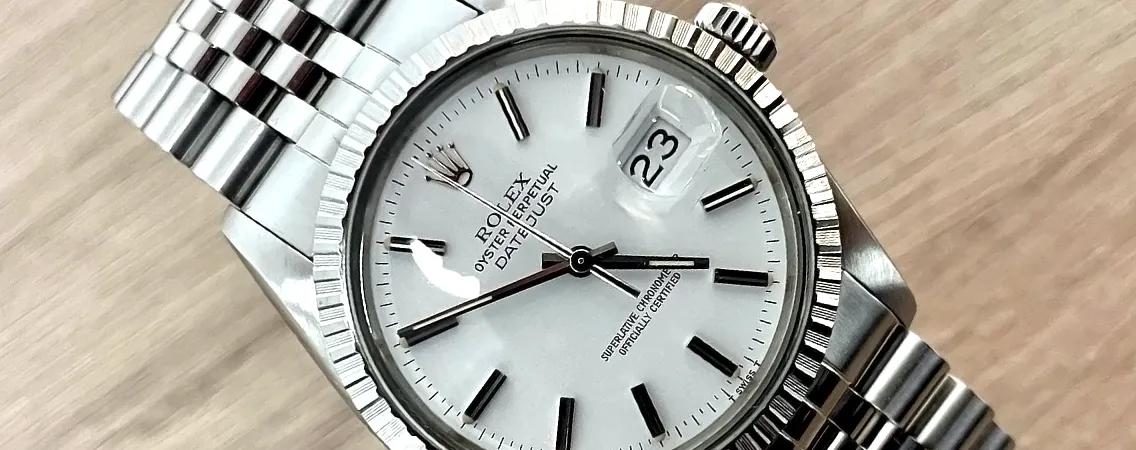
A Rolex serial number is a unique alphanumeric code engraved on the watch case by Rolex during production. It works a bit like a fingerprint – no two watches share the same serial.
The serial number is important for three main reasons:
-
Authenticity – Helps verify that the watch is genuine and not a counterfeit.
-
Dating the Watch – Allows collectors and buyers to estimate when the watch was made.
-
Service & Records – Authorised Rolex service centres use the serial to log maintenance history and verify warranty coverage.
Where to Find Your Rolex Serial Number
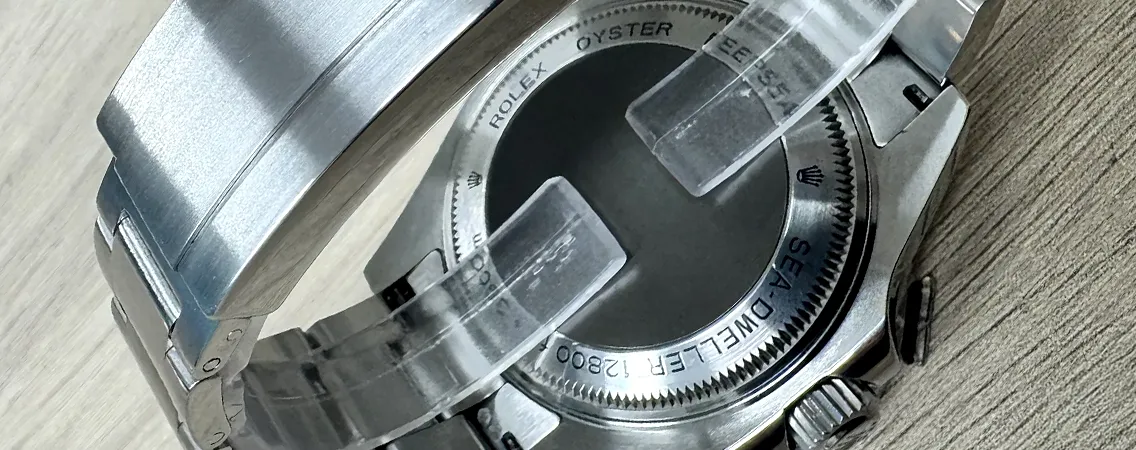
Your Rolex serial number is physically engraved on the watch case, but its exact location depends on the production year. Knowing where to look is the first step in using the chart above.
Pre-2008 Models
-
The serial number is engraved between the lugs at the 6 o’clock position.
-
To see it, you’ll need to remove the bracelet by carefully compressing the spring bars.
-
The engraving runs horizontally along the case, and on older vintage pieces, it may be shallow or worn.
2008 Onward
-
Rolex began engraving the serial number on the rehaut, the inner metal ring between the dial and the crystal, just below the 6 o’clock position.
-
You can view it without removing the bracelet by tilting the watch under good light.
Transitional Models
-
Some watches produced during the switch in 2008–2010 have the serial engraved both on the rehaut and between the lugs.
-
This overlap can be helpful if one engraving is worn or hard to read.
Rolex Serial Number Chart
Below is a Rolex serial number production year chart based on long-established collector data. Rolex does not publish official records, so dates are approximate and may vary by up to 1 – 2 years. Some watches were assembled or sold well after their cases were made, so the serial number is best used as a guide rather than an exact date.
Rolex Serial Number Eras at a Glance
Rolex serial numbers fall into three main formats:
Numeric Serials (1926–1986)
Sequential numbers that increased each year. The earlier the number, the older the watch.
Letter Prefix Serials (1987–2010)
One letter followed by numbers (e.g., K123456). Each letter marks a general production period. Some overlap exists during transitions.
Random Alphanumeric Serials (Mid-2010–Present)
Mix of letters and numbers in no particular order. These cannot be dated by the serial alone – use the warranty card, sales receipt, or Rolex service records instead.
Once you’ve identified your watch’s serial format, scroll to the matching section of the chart below to find the approximate production year.
Randomised Serials (Mid-2010–Present)
Introduced in mid-2010. Serial numbers are random alphanumeric strings and cannot be used to determine the production year. Use the warranty card, sales receipt, or Rolex service centre records for dating.
Serial / Prefix
Years Covered
Random alphanumeric
Mid-2010 – Present (2025)
Letter Prefix Era (1987–2010)
Serial numbers begin with a letter followed by digits. Some years have multiple possible prefixes during transition periods.
Serial / Prefix
Year
G
2010
V
2009
M or V
2008
M or Z
2007
D or Z
2006
D
2005
F
2005
F
2004
F
2003
Y
2002
K or Y
2001
K,000,001
2000
P,000,001
2000
A,000,001
1999
U,932,144
1998
U,000,001
1997
T,000,001
1996
W,000,001
1995
S,860,880
1994
S,000,001
1993
C,000,001
1992
N,000,001
1991
X,000,001
1991
E,000,001
1990
L,980,000
1989
R,598,200
1988
R,000,001
1987
Numeric Era (1926–1986)
Purely numeric serial numbers. Actual production can vary by up to 1–2 years.
Serial / Prefix
Year
9,400,000
1987
8,900,000
1986
8,614,000
1985
8,070,022
1984
7,400,000
1983
7,100,000
1982
6,520,870
1981
6,434,000
1980
5,737,030
1979
5,000,000
1978
5,008,000
1977
4,115,299
1976
3,862,196
1975
3,567,927
1974
3,200,268
1973
2,890,459
1972
2,589,295
1971
2,241,882
1970
1,900,000
1969
1,752,000
1968
1,538,435
1967
1,200,000
1966
1,100,000
1965
1,008,889
1964
824,000
1963
744,000
1962
643,153
1961
516,000
1960
399,453
1959
328,000
1958
224,000
1957
133,061
1956
97,000
1955
23,000
1954
855,726
1953
726,639
1952
709,249
1951
–
1950
–
1949
628,840
1948
529,163
1947
367,946
1946
302,459
1945
269,561
1944
230,878
1943
143,509
1942
106,047
1941
99,775
1940
71,224
1939
43,739
1938
40,920
1937
36,856
1936
34,336
1935
30,823
1934
29,562
1933
29,132
1932
–
1931
23,186
1930
–
1929
23,969
1928
20,190
1927
1
1926
Looking to Sell Your Rolex?
At UK Specialist Watches, we combine decades of expertise with a passion for fine timepieces. If you’re considering selling your Rolex, we can provide you with a free, no-obligation evaluation based on current market trends and your watch’s individual characteristics. Our process is discreet, transparent, and designed to ensure you receive a fair and competitive offer. Contact Us.
How Rolex Serial Numbers Have Evolved
Rolex has used three main serial number formats over the past century, each marking a distinct era in the brand’s production history. Understanding these changes helps explain the groupings in the chart above and why some watches can be dated more precisely than others.
1920s–1950s: Early Numeric Era
-
Rolex began engraving simple sequential numeric serial numbers in the mid-1920s.
-
Production volumes were modest, so numbers increased slowly.
-
These early serials typically have fewer digits and can date a watch to within a year or two using surviving production records.
1960s–1980s: Numeric Acceleration
-
As Rolex expanded globally, production increased and serial numbers rose more quickly.
-
By the early 1980s, 7-digit serials were common.
-
Dating in this period is relatively straightforward; the numbers were still sequential, and the changes year-to-year are well documented by collectors.
Late 1980s–2010: Letter Prefix Era
-
Around 1987, Rolex introduced a single-letter prefix followed by numbers (e.g., R123456).
-
Each letter corresponded to a general production period, helping reduce very long numeric serials.
-
There were overlaps — for example, some years had two possible prefixes during transitions — but dating is still fairly precise in this era.
Mid-2010–Present: Randomised Alphanumeric Era
-
Rolex moved to random alphanumeric serials around mid-2010.
-
These have no sequential logic, meaning you cannot determine a watch’s age from the serial alone.
-
Dating a modern Rolex now requires a warranty card, sales receipt, or confirmation from a Rolex service centre.
This change was designed to combat counterfeiting and grey-market speculation.
The Relationship Between Rolex Serial Numbers & Reference (or Model) Numbers
Every Rolex has two key identifiers: the serial number and the reference number. Together, they tell you both when a watch was made and what it was meant to be when it left the factory.
The serial number is unique to each case. Depending on its format, it can give you an approximate production year, as explained above. The reference number, engraved between the lugs at 12 o’clock, identifies the exact model, its materials, and often its bezel style. For example, a 16610 is a stainless steel Submariner Date with aluminium bezel insert, while a 116610LN is its ceramic-bezel successor.
When these two numbers match up with known production timelines, they create a consistent picture of the watch’s identity. A serial pointing to 1999 on a Submariner 16610 makes sense; that model was in production from 1989 to 2010. But a 1991 serial paired with a 116610LN would be impossible, as that model was introduced in 2010.
Once you’ve checked the serial and reference together, other details can help confirm they’re both correct for the watch:
-
A bracelet clasp code can indicate when the bracelet was made.
-
Markings inside the case-back can confirm the case’s production date.
-
Original warranty papers may show a country code, revealing where the watch was first sold.
-
Dial fonts, hand styles, and even luminous material can be tied to specific eras.
Model-Specific Nuances & Red Flags
While the serial and reference number relationship is a reliable guide for most Rolex watches, there are exceptions. Certain models, transitional periods, and special editions can show details that don’t perfectly align with the general chart, and that doesn’t always mean there’s something wrong.
Overlapping Production Runs
Rolex often produced multiple generations of the same model at the same time, especially during transition years. For example, late aluminium-bezel Submariner 16610 models were still leaving the factory months after the ceramic-bezel 116610LN had been introduced. This can lead to overlap between the serial numbers of outgoing and incoming references.
Transitional References
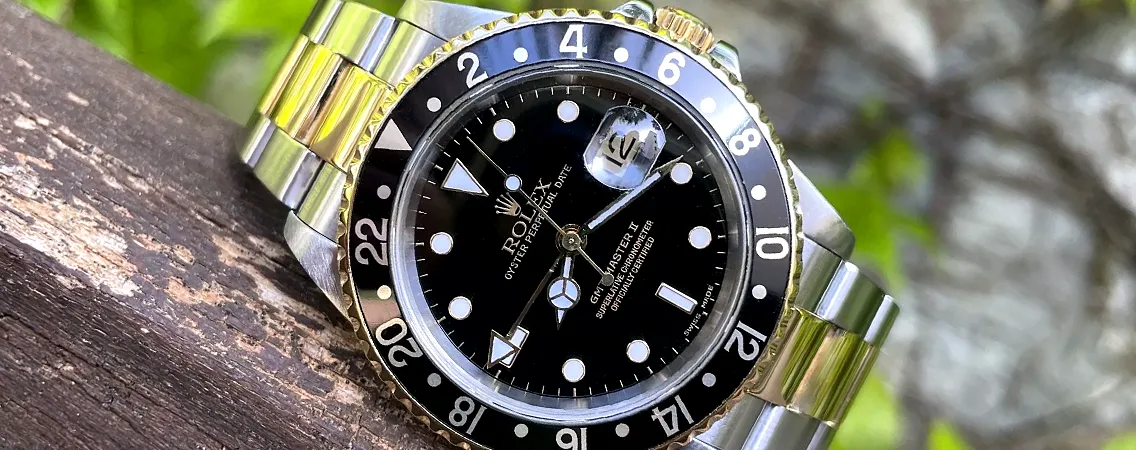
Some models feature a mix of old and new design elements. Collectors refer to these as transitional references. A good example is the late-1980s GMT-Master 16750, which can have either matte dials without white gold surrounds or glossy dials with surrounds, depending on production timing.
Dial & Component Variations
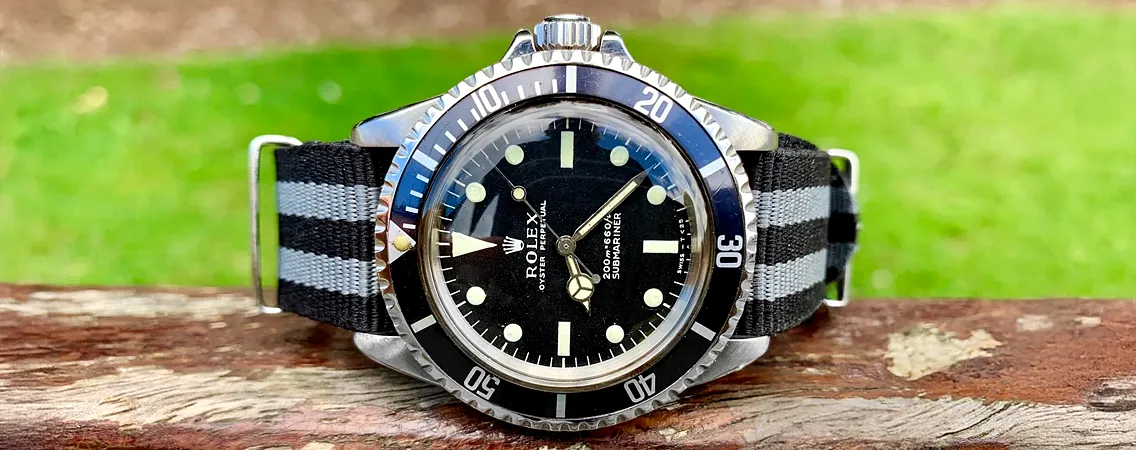
Rolex regularly updates dial text, lume type, and hand shapes within a model’s lifespan. This means two watches with the same reference and similar serials could have different dial layouts, both of which are correct for their year. Vintage Submariners, for example, can have multiple “Mark” dial variations within the same reference.
Service Replacements
Rolex service centres sometimes replace cases, dials, or bracelets during maintenance. A watch with a service case will have a newer serial than its original, even though other parts date from an earlier period. Service dials and hands may also use more modern materials like Super-LumiNova, replacing older tritium lume.
Counterfeit Red Flags
Fakes sometimes feature serial numbers that don’t match the model or era, or poor-quality engraving that’s inconsistent with Rolex standards. A 1990s serial on a model introduced in the 2010s, for example, would be a strong warning sign.
Key takeaway: If something seems unusual, check other identifiers such as bracelet clasp codes, case-back stamps, and original paperwork. If uncertainty remains, have the watch inspected by a trusted Rolex specialist, like us here at UK Specialist Watches.
Bringing It All Together
Checking a Rolex’s serial number alongside its reference number, clasp code, and other identifying details gives you a far more complete understanding of the watch than relying on any single clue. For example, a Submariner with a “Y” prefix serial points to 2002 production — if its reference number matches a model that was available in that year, and the clasp code confirms a similar production date, you can be confident the watch is consistent and likely original.
These checks not only help confirm authenticity but also provide important context about a Rolex’s production period, originality, and potential market value.
How We Can Help
If you have any questions about dating or verifying a Rolex, our experts at UK Specialist Watches are here to help.
Thinking of selling? We offer a free, no-obligation evaluation to help you understand your watch’s market value.
Looking to buy? Browse our carefully curated selection of Rolex watches, including vintage and rare pieces, all inspected and verified by our specialists.
Whether you are buying, selling, or simply learning more about your own watch, understanding the serial number is an essential step in truly knowing your Rolex, and we’re here to guide you every step of the way.